

In this blog, Chandrika Kaviraj, lived expert and former carer, and Andy Bradshaw, Manager of the EMPOWER Dementia Network+ and Research Fellow, reflect on their experience co-producing and co-presenting at our the 2025 HSR UK Annual Conference. They share personal and professional perspectives on what meaningful co-production looks like in practice, how it shaped their session and what others can take from their approach to build more inclusive and collaborative research.
Co-Authors: Chandrika Kaviraj, lived expert, carer for late parents who lived with dementia and Andy Bradshaw, The EMPOWER Dementia Network+ Manager and Research Fellow
Inequalities in dementia care and research (Chandrika and Andy)
People affected by dementia want to live as well as possible, staying connected to themselves, others, and their surroundings through meaningful activities. However, many groups remain underserved, facing barriers to care and research participation.
I (Chandrika) was an unpaid carer for my parents who had dementia, but for many years, carers like me have been invisible to society, academics, and clinicians. This gave me first-hand insight into the caring duties, admin, and emotional rollercoaster involved in caring for people with dementia - including the heartbreaking sense of ‘could I have done more?’
It also made me question how systems (health and social care, academic, and political) supported me - or didn’t - in doing my best for the people I loved wholeheartedly. These experiences have led to me becoming a vociferous advocate and campaigner on inequalities in dementia care and research.
The EMPOWER Dementia Network+ (Andy)
It is on the shoulders of people like Chandrika that the EMPOWER Dementia Network+ is built. EMPOWER is a large, UK-wide network committed to addressing inequalities in dementia care and research. We bring together community groups, lived experts, health and social care practitioners, and researchers from across primary, social, palliative, and dementia care with the aims of:
- Working together to find creative ways to make a positive difference in dementia care and research
- Hearing the voices of people from marginalised, vulnerable, and underserved groups to learn what matters to them
- Finding new ways to do research that mean more people with dementia can take part
Co-production is at the heart of everything we do at EMPOWER (Chandrika and Andy)
The importance of co-production from a lived expert’s perspective (Chandrika)
Together we have learned - and continue to learn - how people with lived experience bring unique and powerful skillsets to building our Network in impactful ways. Although people with lived experience don’t necessarily have PhDs, involving them as equal partners means we can harness their professional and personal expertise to address inequalities in meaningful ways.
The importance of co-production from a researcher’s perspective (Andy)
Co-production is about fairness, equity, and making a real difference. People affected by dementia live with the impact of research, policy, and care decisions every day, so it’s only right they can shape them - regardless of background, identity, or circumstances. Working with the right people through the principles of co-production better ensures that we focus on what really matters to people and do so in ways that have the greatest impact.
Our process of co-production at Health Services Research Conference 2025 (Andy)
The HSR conference gave us the chance to showcase what the EMPOWER Dementia Network+ is aiming to achieve and how we work. Together, we (Andy and Chandrika) co-produced and co-presented our oral presentation. We began by submitting an abstract with other EMPOWER team members and, over two weeks, met virtually four times to shape and rehearse what we presented. Before we knew it, we were on the 5:48am train from King’s Cross to Newcastle … and then standing in front of a national audience sharing a year’s worth of work on inclusive co-production.
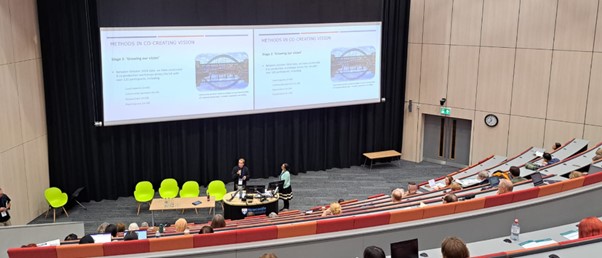
Co-presenting on the EMPOWER Dementia Network+ at Health Services Research Conference 2025
Reflections: What we learnt, and others can learn, from our experience and way of working (Chandrika and Andy)
Co-producing a presentation and co-presenting at a conference is a step away from any health research project we’ve ever been involved with, so it’s been a learning curve for us both, as well as an opportunity to learn and share ideas.
Chandrika
My parents both passed away within nine months of one another last year, and it is still raw. With this conference, I felt I could channel that passion, combined with grief, and put the energy to good use. I wanted to get that across but also work out how to help others going forward.
It helped that I had met Andy face-to-face previously, but we developed a working collaboration because we’re both passionate about dementia care and doing impactful work. The practical nature of the Network, and the can-do, committed approach of the team means this really feels like it could happen. That is unusual for a lived expert to witness - let alone be part of - and it is refreshing.
Fundamental to doing co-production well was treating each other as equals so that everyone feels heard and valued. Co-production is as though we have different segments of a jigsaw, and without one, we cannot have the other. I always felt Andy’s equal - right through to him insisting I sit on the panel of researchers when answering the audience’s questions. This is something that feels incredible and brings out the best in any lived experience partner; it enabled me to feel compelled and able to free flow about public involvement in the Q&A panel with confidence.
The key message I shared on the panel was the importance of representation. When people see themselves reflected in research and other institutions, it builds trust that researchers ‘get us.’ If those with lived experience can recognise their peers among academics, clinicians, and policymakers it sends a powerful signal: a diverse cross-section of society is shaping research about us, and that makes it easier to trust the process.
Andy
For me, perhaps the most important and enjoyable part of this experience was everything in between our preparation and presentation: chatting for the entire train journey to Newcastle, wandering around the city after the conference, and enjoying each other’s company. The foundations of good co-production are strong relationships, and the foundations of strong relationships are built through the time and energy you put into them.
I’m grateful that not only did HSR conference provide a platform for us to build these foundations but actively encouraged it from the outset. Co-production is rarely easy, but, if done well, is always worth the time, energy, and emotions needed for it to work. You can find out more about the EMPOWER Dementia Network+, what we do, and opportunities to be involved here: www.empowerdementia.co.uk